3 Ways to Pay for Solar: Loans, Leases & Power Purchase Agreements (PPA)

Homeowners have a variety of financing options available to facilitate the switch to solar energy. To make the best decision for you and your family, it's important to explore various payment methods including loans, leases, and power purchase agreements (PPAs).
Key Takeaways
A solar loan allows homeowners to own their solar energy systems by borrowing money.
Leases & Power Purchase Agreements allow homeowners to use solar power without owning the system.
Consult a tax professional, financial advisor, or solar energy consultant for personalized insights.
Join the millions of Americans who have embraced the solar revolution, driven by the desire for energy independence, the pursuit of cost savings, and a commitment to environmental responsibility. Yet, amidst this enthusiasm, a common question arises: 'How will I pay for solar?'
To circumvent the pitfalls of high-interest credit cards and the need to tap into personal savings, it's worth exploring all available options. The most popular and accessible solutions for residential solar are loans, leases, and power purchase agreements (PPA). Understanding how each works will help you choose the right financing for your needs.
Option 1: Solar loans
What is a solar loan?
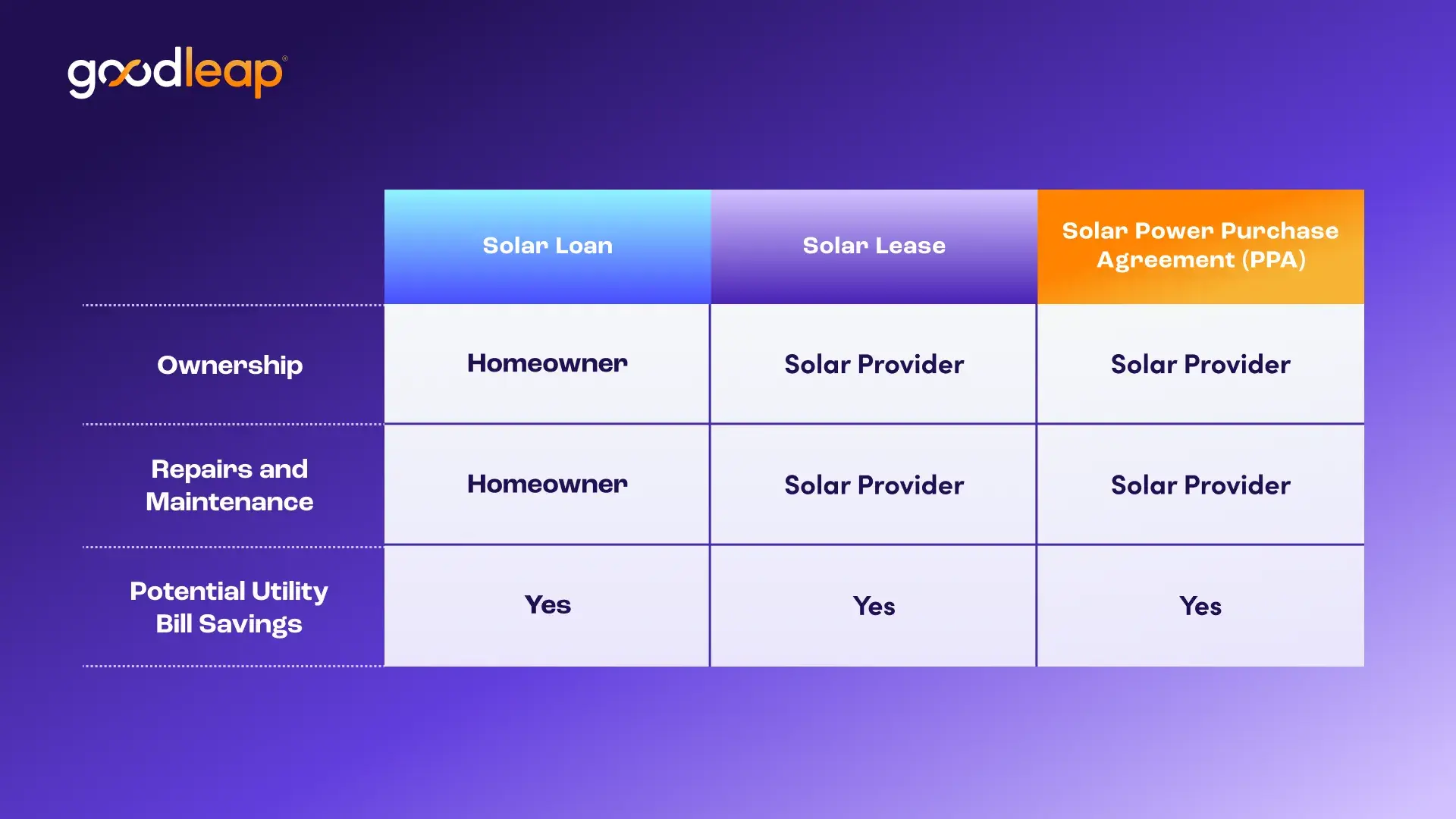
A solar loan is a financial tool that enables homeowners to finance the purchase of solar panel systems. With solar loans, the homeowner owns the solar panels outright. The loan covers the upfront cost of purchasing and installing the solar panels, which are then paid off over time through fixed monthly installments. Interest rates for solar loans can vary, but they are typically fixed, providing predictability in monthly payments.
Homeowners who own their solar system can take advantage of opportunities like Virtual Power Plant (VPP) programs, where excess stored energy can be shared with the grid to earn rewards. Combined with predictable energy bill savings and full control over their energy use, these features contribute to the overall long-term value of solar ownership.
Solar loans offer homeowners an accessible and cost-effective way to transition to solar energy while retaining ownership and control over their energy future.
Learn more about solar loans here.
Option 2: Solar leases
What is a solar lease?
A solar lease is a financial arrangement that, like a loan, allows homeowners to benefit from solar energy without the upfront costs of purchasing a system outright. But, instead of owning the solar panels, you lease or “rent” them.
With a solar lease, the solar provider owns and maintains the solar panels, while the homeowner benefits from the electricity generated and reduced electricity bills as a result of using solar energy. The fixed monthly payment is determined at the beginning of the lease based on the estimated power the system will produce. Additionally, depending on the terms of the lease, the leasing company may pass on state and federal benefits to the homeowner through lower monthly payments.
A solar lease offers homeowners a convenient way to benefit from solar energy without the responsibility of ownership or maintenance of the solar panel system.
Learn more about solar leases here.
Option 3: Power purchase agreements (PPA)
What is a power purchase agreement (PPA)?
A power purchase agreement (PPA) is a contract between a homeowner and a third-party company, in which the homeowner buys electricity generated by solar panels at a predetermined rate. The third party, typically a solar provider, owns the solar panels and is responsible for maintenance.
PPAs can either have fixed monthly payments that may or may not increase annually just like a lease, or they can vary monthly based on the amount of power the system produces. Although the third party primarily benefits from any incentives, homeowners may still see reduced solar energy costs if some benefits are passed on to them.
Power purchase agreements offer homeowners a hassle-free way to access solar energy and realize immediate savings on their electricity bills without the need for upfront investment or maintenance.
Which solar financing option is right for you?
When choosing the best payment option for transitioning to residential solar, there are a variety of factors to consider. These include your current budget, long-term financial objectives, and preferences regarding ownership.
Make an informed decision
Whether opting for a solar loan, lease, or power purchase agreement (PPA), choosing the right financing option is an important decision. To make the best choice, it’s crucial to carefully read and understand the terms of the loan, lease, or PPA agreement. Consulting with a financial advisor or solar energy consultant can also provide personalized insights based on your financial situation and energy needs.
Today, thanks to the variety of flexible financing options, clean energy is more affordable and accessible than ever. Learn more about going solar here.